Infrastructure
Homelab Kubernetes Cluster
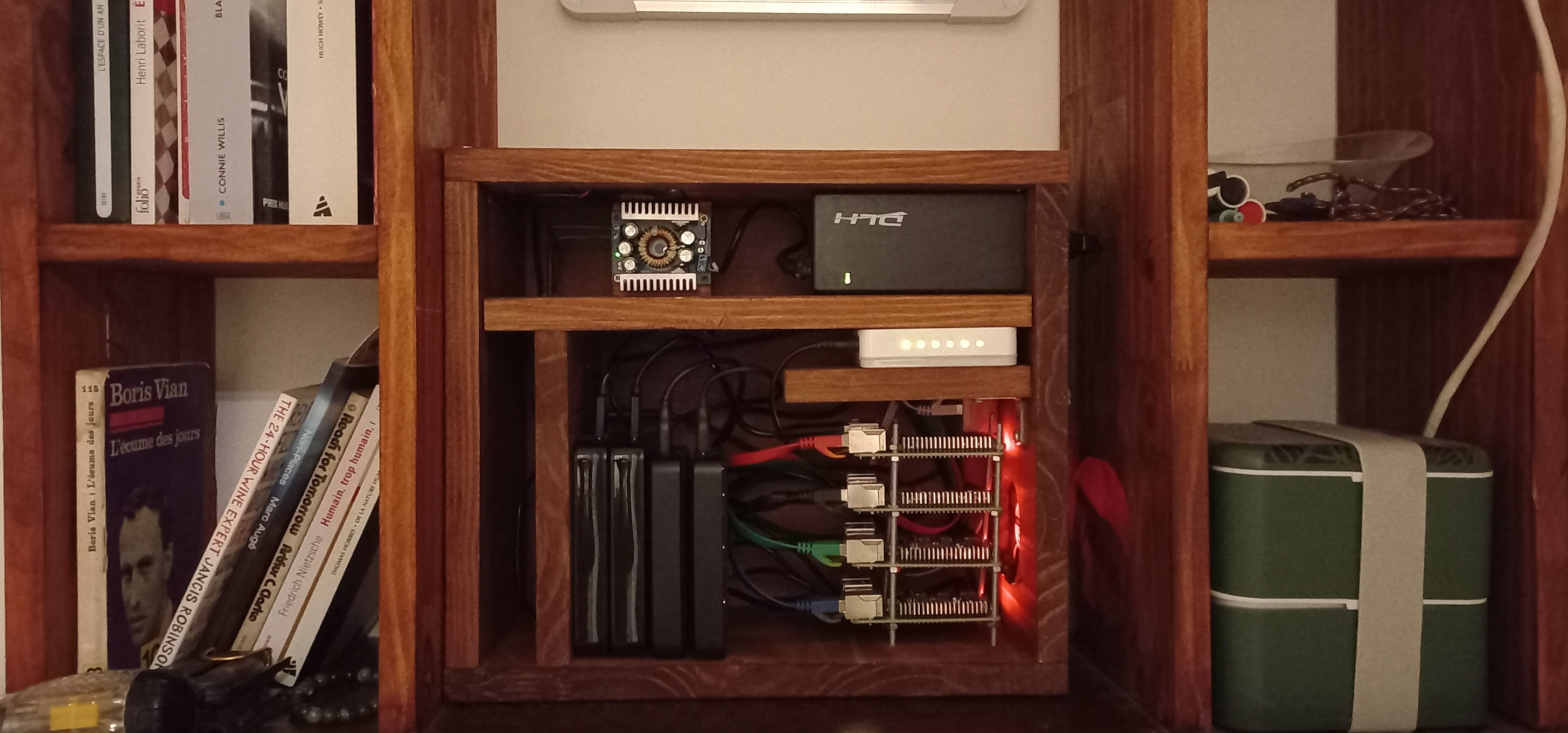
4-node k3s cluster on Raspberry Pi with Longhorn distributed storage, monitoring and self-hosted services.
Context
I wanted to push my homelab beyond a simple NAS or single server. The goal: a resilient, reproducible infrastructure close to a real production environment, but on low-power ARM hardware.
Architecture
The cluster runs on 4 Raspberry Pi 4 (8 GB RAM each) connected over Gigabit Ethernet:
- 1 dedicated control plane
- 3 worker nodes with Longhorn distributed storage
- Pi-hole for DNS/DHCP and network filtering
- Traefik as ingress controller with automatic TLS certificates
Self-Hosted Services
- Immich — photo management, Google Photos style
- Gitea — private Git repository
- Docker Registry — private image registry
- Joplin — note synchronization
- Radicale — CalDAV/CardDAV
Power Management
I built a DIY UPS with LiPo batteries and an Arduino controller to trigger a graceful cluster shutdown on mains failure. A script monitors battery voltage over I2C and sends sequenced shutdown commands.
Challenges
Longhorn recovery after reinstallation was the most complex challenge — I had to manually recreate volume mappings to preserve existing data without proprietary formats.
What I Learned
- Fine-grained resource management on constrained ARM nodes
- Deep network debugging (CNI, kube-proxy, CoreDNS)
- Backup strategies without vendor lock-in